 ← Aventis Press
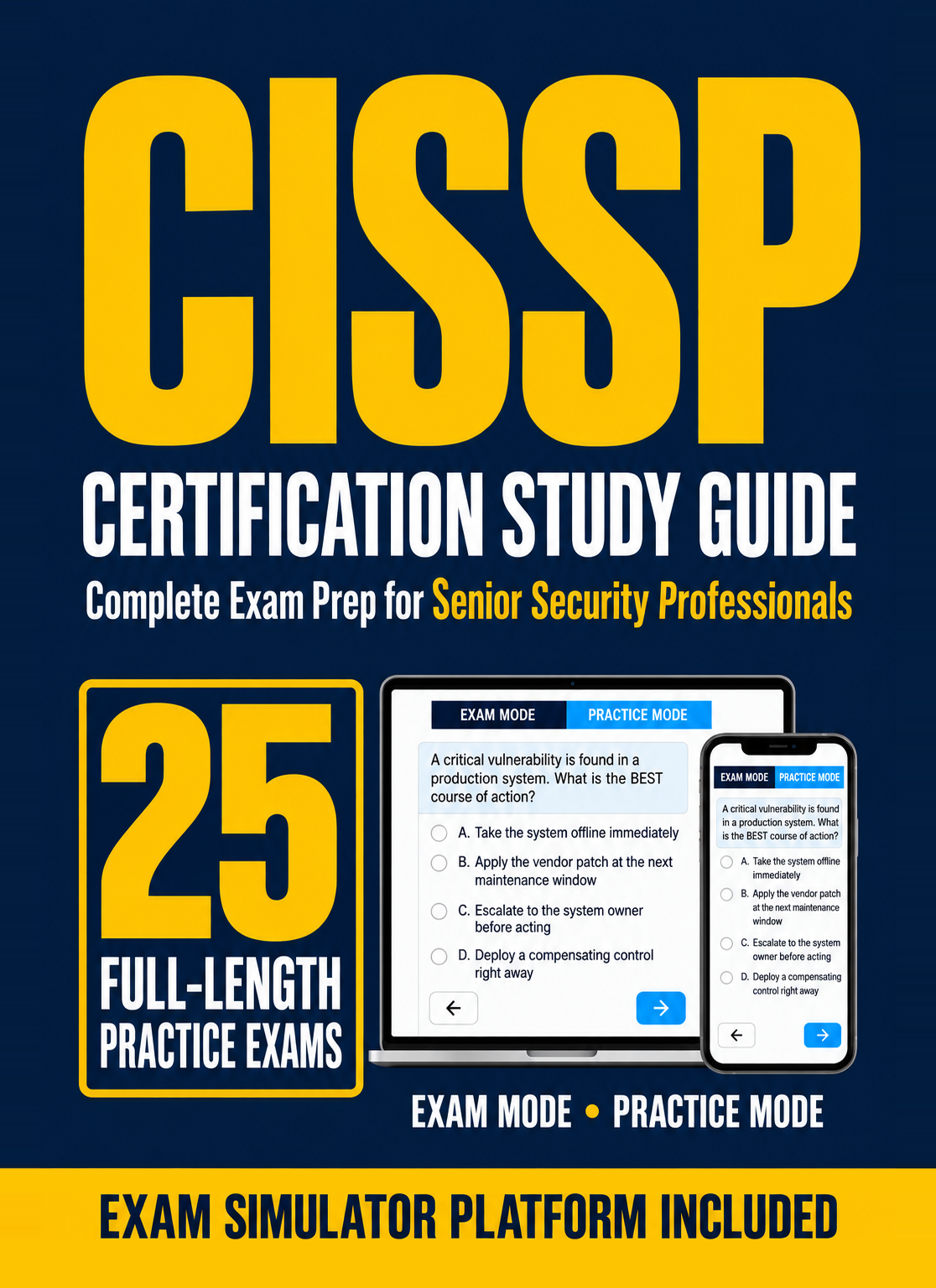
CISSP Certification Study Guide
The complete exam prep for senior security professionals, with all eight domains, scenario-based practice, and a strategy for choosing the best answer.
What this guide covers
The book's own chapter-by-chapter structure: exam orientation and the Altitude Method first, then all eight CISSP domains in full, through to the closing review toolkit.
Understanding the Exam
- 1.1 The purpose, scope, and eight-domain blueprint
- 1.2 The adaptive exam: how CAT actually works
- 1.3 Scoring, pass/fail, and practice readiness
- 1.4 Experience requirements, the Associate of ISC2 path, and the 2026 waiver update
- 1.5 Timing, test-day rules, and the test-day plan
The Altitude Method
- 2.1 From technical correctness to enterprise judgment
- 2.2 The Altitude Method: altitude, angle, anchor
- 2.3 Reading the scenario across eight domains
- 2.4 Choosing the best answer and eliminating plausible distractors
- 2.5 Judgment ties, knowledge gaps, and deciding without a second look
Domain 1, Security and Risk Management 16% of the exam
- 3.1 Professional ethics, core security concepts, and governance principles
- 3.2 Legal, regulatory, and compliance issues, investigations, and the policy hierarchy
- 3.3 Risk management concepts, threat modeling, and supply chain risk
- 3.4 Business continuity, personnel security, and security awareness programs
- 3.5 Domain 1 review and best-answer drills
Domain 2, Asset Security 10%
- 4.1 Classifying and handling information and assets
- 4.2 Secure provisioning and asset retention
- 4.3 The data lifecycle and data security controls
- 4.4 Domain 2 review and best-answer drills
Domain 3, Security Architecture and Engineering 13%
- 5.1 Secure design principles, security models, control selection, and system security capabilities
- 5.2 Vulnerabilities across modern architectures
- 5.3 Cryptographic solutions and cryptanalytic attacks
- 5.4 Site and facility security, and the information system lifecycle
- 5.5 Domain 3 review and best-answer drills
Domain 4, Communication and Network Security 13%
- 6.1 Network architecture fundamentals
- 6.2 Segmentation, wireless, and modern network design
- 6.3 Securing network components
- 6.4 Secure communication channels
- 6.5 Domain 4 review and best-answer drills
Domain 5, Identity and Access Management (IAM) 13%
- 7.1 Access control fundamentals and authentication strategy
- 7.2 Federated identity and authentication systems
- 7.3 Authorization mechanisms
- 7.4 The identity and access provisioning lifecycle
- 7.5 Domain 5 review and best-answer drills
Domain 6, Security Assessment and Testing 12%
- 8.1 Assessment, test, and audit strategy
- 8.2 Conducting security control testing
- 8.3 Collecting process data and reporting results
- 8.4 Domain 6 review and best-answer drills
Domain 7, Security Operations 13%
- 9.1 Investigations, logging, and configuration management
- 9.2 Foundational operations concepts, resource protection, and incident management
- 9.3 Detection, prevention, patch, and change management
- 9.4 Recovery strategies and disaster recovery processes
- 9.5 Business continuity planning, physical security, and personnel safety
- 9.6 Domain 7 review and best-answer drills
Domain 8, Software Development Security 10%
- 10.1 Security in the software development life cycle
- 10.2 Security controls in development ecosystems and secure coding
- 10.3 Assessing software security and acquired software risk
- 10.4 Domain 8 review and best-answer drills
Final Review Toolkit
- 11.1 The eight-domain flow: how the domains interlock
- 11.2 Frameworks and standards comparison
- 11.3 Operational checklists by domain
- 11.4 Scenario signals, key terms, and the final 48-hour review plan
Accessing and Using the Online Practice Platform
How the guide handles it
CISSP candidates rarely fail on raw recall. The harder problem is choosing between two or three answers that are all technically defensible, which is why this guide teaches the Altitude Method: for every scenario, identify the right altitude (technical control, operational process, or enterprise governance), the governing principle at that altitude, and the choice that serves the organization as a whole rather than just the control in front of you.
Each of the eight domains above is covered with original scenario questions in addition to the explanatory chapters, and the book closes by pointing to a separate Exam Simulator Platform with 25 full-length practice exams in both Exam Mode and Practice Mode.